
The quiet epidemic no one is talking loudly enough about
More than 30 million Americans are losing their hearing — and with it, their memory, their balance, and their conversations. A new at-home therapy targets the one thing hearing aids can't: the cells themselves.

You've probably done it too. You nod and smile. Your daughter finishes a story at dinner, and you caught maybe half of it. The consonants blur together — the s sounds vanish first, then the fs, then whole names. You say "what?" once, maybe twice. After the third time, it feels easier to just laugh when everyone else laughs.
This is how it starts. Not with deafness. Not with a diagnosis. Just small, accumulating retreats from the conversations that used to come easily.
And for decades, this slow fade has been dismissed as an inevitable part of getting older — something to eventually treat with a $4,000 beige device tucked behind the ear. But researchers at Harvard, Johns Hopkins, and institutions across the world have been quietly reshaping that picture. Age-related hearing loss isn't just a nuisance. It's one of the most consequential — and most underestimated — health signals in the body.
And the way we've been treating it may be the least interesting part of the story.
Part I · The StakesWhy your ears are talking to your brain
The 2020 Lancet Commission on dementia prevention did something unusual. It ranked twelve modifiable risk factors for cognitive decline, and placed a single one at the top of the list.
Not smoking. Not blood pressure. Not physical inactivity.
Hearing loss.
Even mild hearing impairment — the kind most people barely notice — is associated with roughly double the long-term risk of dementia. The mechanism is still being studied, but the leading theory is disarmingly intuitive: when the ear stops sending clear signals, the brain works harder to fill in the blanks. That cognitive tax, applied relentlessly over years, appears to accelerate the kind of neural wear-and-tear that eventually shows up as memory loss.
The cascade doesn't stop at cognition.
Hearing loss is not a hearing problem. It's a brain problem, a balance problem, and — increasingly — a loneliness problem.— Johns Hopkins Bloomberg School of Public Health
Part II · The GapWhy hearing aids are solving the wrong problem
Hearing aids are extraordinary pieces of engineering. They can separate a voice from the din of a restaurant, compress dynamic range, and feed the sound directly into the ear canal. For many people, they are life-changing.
But strip away the price tag — which, at an average of $4,672 for a pair not covered by Medicare, is its own barrier — and a more fundamental issue remains:
Hearing aids amplify sound. They don't restore hearing.
They are, in the truest sense, a workaround. They compensate for a failing system rather than repair it. And they are silent on tinnitus — the relentless ringing that affects an estimated 50 million Americans, often alongside hearing loss, and for which conventional medicine offers remarkably little.
To understand why, you have to go a few millimeters deeper into the ear — to a spiral-shaped, fluid-filled structure the size of a pea.
The cells you hear with are tiny. And they die quietly.
Inside the cochlea, your inner ear, are roughly 15,000 hair cells — microscopic sensors tipped with bundles of stereocilia that bend when sound waves pass through the cochlear fluid. That bending is the moment sound becomes signal. Everything you've ever heard began here.
These cells are exquisitely sensitive and famously fragile. Noise exposure damages them. So does aging. So do certain medications, and poor circulation, and oxidative stress. And for decades, the prevailing wisdom in audiology was blunt: once hair cells die, they don't come back.
But that's not quite the full story. Between "healthy" and "dead" lies a wide gray zone — cells that are stressed, under-energized, inflamed, or mitochondrially exhausted, but still structurally intact. Not dead. Just not working.
The cutting edge of hearing research, it turns out, is focused on that gray zone. And on one remarkably low-tech intervention that appears to pull cells back from it.
Part III · The ScienceWhen light becomes medicine
The idea that certain wavelengths of red and near-infrared light can influence cellular function isn't new. It's been studied under various names — photobiomodulation, low-level light therapy, PBMT — for more than half a century. NASA used it to accelerate wound healing in orbit. Dermatologists use it for skin repair. Neurologists are studying it for Alzheimer's, Parkinson's, and traumatic brain injury.
The biology is elegant. Inside nearly every cell in your body is a small organelle called the mitochondrion — the cellular power plant. At the end of its energy-production chain sits an enzyme called cytochrome c oxidase. This enzyme happens to absorb light in a very specific window: roughly 630 to 830 nanometers — the deep red and near-infrared part of the spectrum.
When that light reaches cytochrome c oxidase, it does something strange and consequential. It unsticks the enzyme, allowing it to produce energy (ATP) more efficiently. Tired cells start working again. Inflammation drops. Nitric oxide is released, improving local blood flow. Antioxidant defenses activate.
In other words: light, at the right dose and wavelength, can coax struggling cells back into action.
And the cochlea — that pea-sized spiral of fluid and hair cells — turns out to be one of the most promising places in the body to apply this.
What happens when that light reaches the cochlea unfolds in four distinct stages — and understanding them makes the rest of this story make sense.
Light reaches the inner ear
The 630–830 nanometer window is sometimes called the "optical window of tissue" because it passes through skin, cartilage, and bone with remarkably little scatter. Delivered through the ear canal, it arrives at the cochlea intact.
Cells get an energy boost
The photons are absorbed by cytochrome c oxidase in the mitochondria of hair cells and supporting structures, unblocking the electron transport chain. ATP production rises. Exhausted cells come back online.
Inflammation falls, blood flow rises
Nitric oxide is released, dilating the microvasculature feeding the cochlea and improving oxygen delivery. At the same time, antioxidant defense pathways activate — protecting hair cells from the oxidative stress that drives further decline.
Struggling cells are rescued
Between "healthy" and "dead" lies a window of rescue. Cells in this gray zone — alive but failing — are precisely the ones photobiomodulation appears to help most. Restoring their energy and reducing inflammation can pull them back into working function.
The cells aren't necessarily dead. Many are just too tired to fire. Giving them the right kind of light is, in a real sense, giving them their job back.— Photobiomodulation research summary
Part IV · The DeviceBringing a clinical tool home
For years, photobiomodulation for hearing lived almost exclusively in specialist clinics and academic trials. The equipment was bulky, the sessions expensive, and the access limited. What changed is engineering.
Specifically, the miniaturization of medical-grade LED arrays — the same kind of refinement that turned infrared light panels from $30,000 dermatology fixtures into devices small enough to wear. One of the companies working on this, Primo Goods, has spent the last few years adapting the technology into a consumer device aimed specifically at the cochlea.
They call it HearLight.
A 20-minute session. A neckband. That's it.
HearLight is a wearable red & near-infrared therapy device — a lightweight neckband with specialized ear tips that deliver a clinical-grade 630–830 nm wavelength directly toward the cochlea. One button. Twenty minutes. Read a book while it works.
- Hear conversations clearly again
- Protect against further age-related decline
- Relieve tinnitus — silence the ringing
- Comfortable & durable — just 43 grams
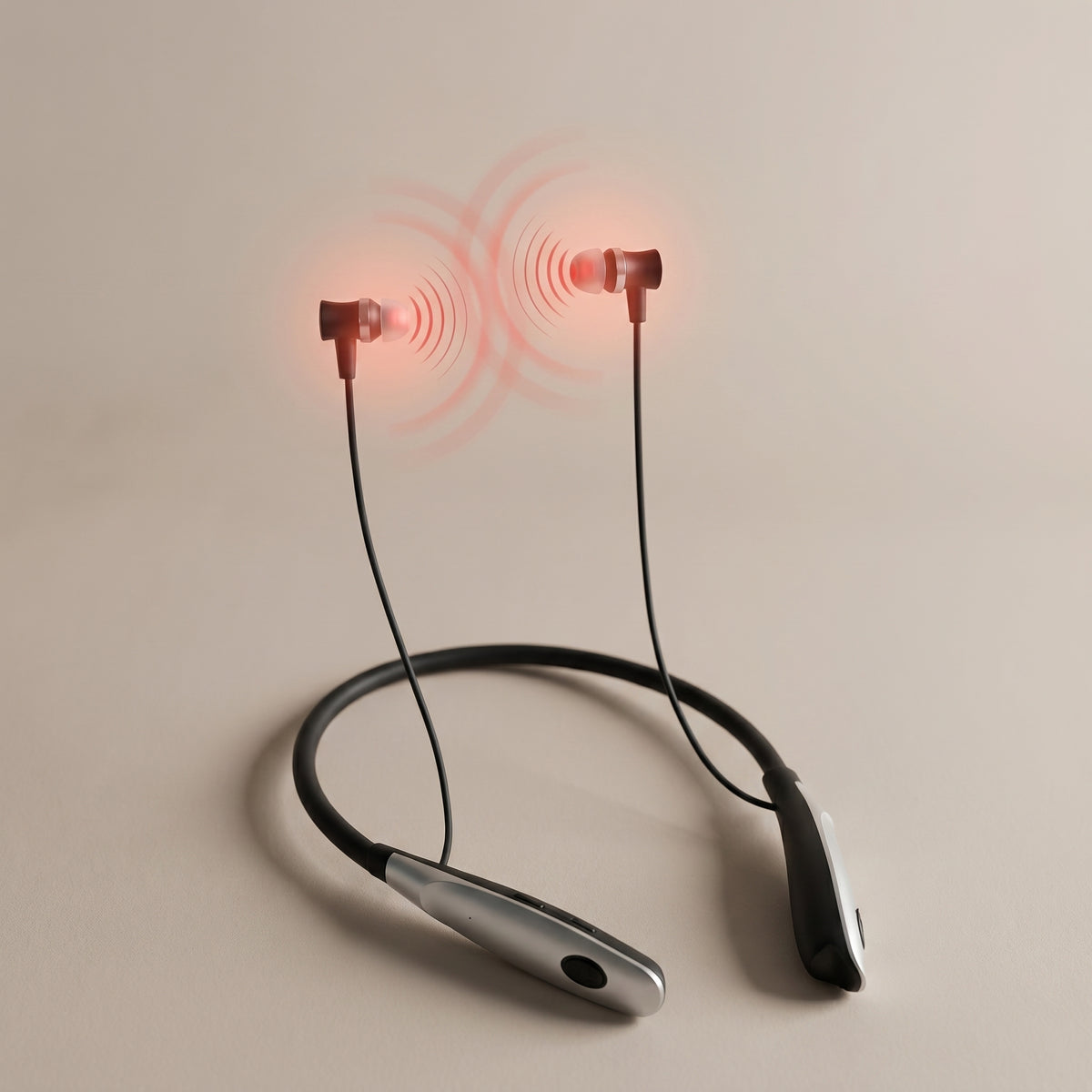
The approach is unlike hearing aids in almost every respect. It does not amplify sound. It does not sit visibly in the ear all day. It is not a workaround. Instead, it targets the underlying biology that the hearing aid industry has effectively conceded as lost territory.
90% of HearLight users report clearer hearing within the first 90 days of consistent use. For tinnitus — that relentless internal ringing — 90% report measurable relief, with the average user noticing improvement within four weeks.
The price, at $99.95, is a fraction of a single hearing aid — let alone the pair most audiologists recommend. There is no prescription, no fitting appointment, no ongoing battery or cleaning supplies. The session takes twenty minutes. You wear it while reading, watching TV, or making dinner.
What users are saying
HearLight vs. traditional hearing aids
| Hearing Aids | HearLight | |
|---|---|---|
| Addresses root cause | ✕ | ✓ |
| Protects against further decline | ✕ | ✓ |
| Tinnitus relief | ✕ | ✓ |
| Worn all day | Yes, visibly | 20 min/day only |
| Ongoing costs | Batteries · fitting · repairs | None |
| Price | $4,672+ | $99.95 |
What readers most commonly ask
Is this the same red light therapy I've seen for skin?
The underlying mechanism — photobiomodulation via the 630–830 nm wavelength window — is the same principle being studied for skin repair, brain injury, and wound healing. HearLight's contribution is the form factor: directing that wavelength specifically toward the cochlea, at the dose range examined in hearing research, using a device you can use at home rather than in a clinic.
Can it actually restore hearing I've already lost?
HearLight is designed to target hair cells in the "window of rescue" — cells that are stressed, inflamed, or energy-starved, but structurally intact. For many users, restoring these cells translates to clearer hearing and reduced tinnitus. For hair cells that are fully dead, no current therapy can regrow them. Results vary, which is why Primo Goods offers a 90-day money-back guarantee.
How long until I notice a difference?
Most users report early improvements within 2–4 weeks of daily 20-minute sessions, with continued gains through 90 days of consistent use. Tinnitus relief averages around 4 weeks. Hearing clarity tends to build more gradually.
Is red light therapy safe?
Photobiomodulation at the 630–830 nm range has one of the longest safety records of any light-based therapy, with decades of clinical use. HearLight operates well below thermal damage thresholds. As with any new health regimen, consult your physician — especially if you have a diagnosed ear condition.
Can I use HearLight alongside my hearing aids?
Yes. HearLight is not worn during hearing-aid use — you wear it for 20-minute sessions, typically while reading or relaxing, then set it aside. The two approaches target different problems: hearing aids amplify sound; HearLight targets the cellular health of the inner ear itself.
What if it doesn't work for me?
Primo Goods offers a 90-day money-back guarantee. If you don't notice an improvement, return the device for a full refund — no questions asked. Every HearLight is also backed by a 2-year warranty against defects.
Hear life clearly again.
Join 1,200+ customers who've rethought what's possible for their hearing — without fitting appointments, batteries, or five-figure price tags.