
Your Carbon Monoxide Detector Cannot Detect Gas. Most Families Don’t Learn That Until The House Explodes.
I’m a firefighter. I’ve pulled CO detectors out of two different houses this year — green light still on, batteries still in, working perfectly. Both detectors had nothing to do with what happened. Here’s why yours might not either.

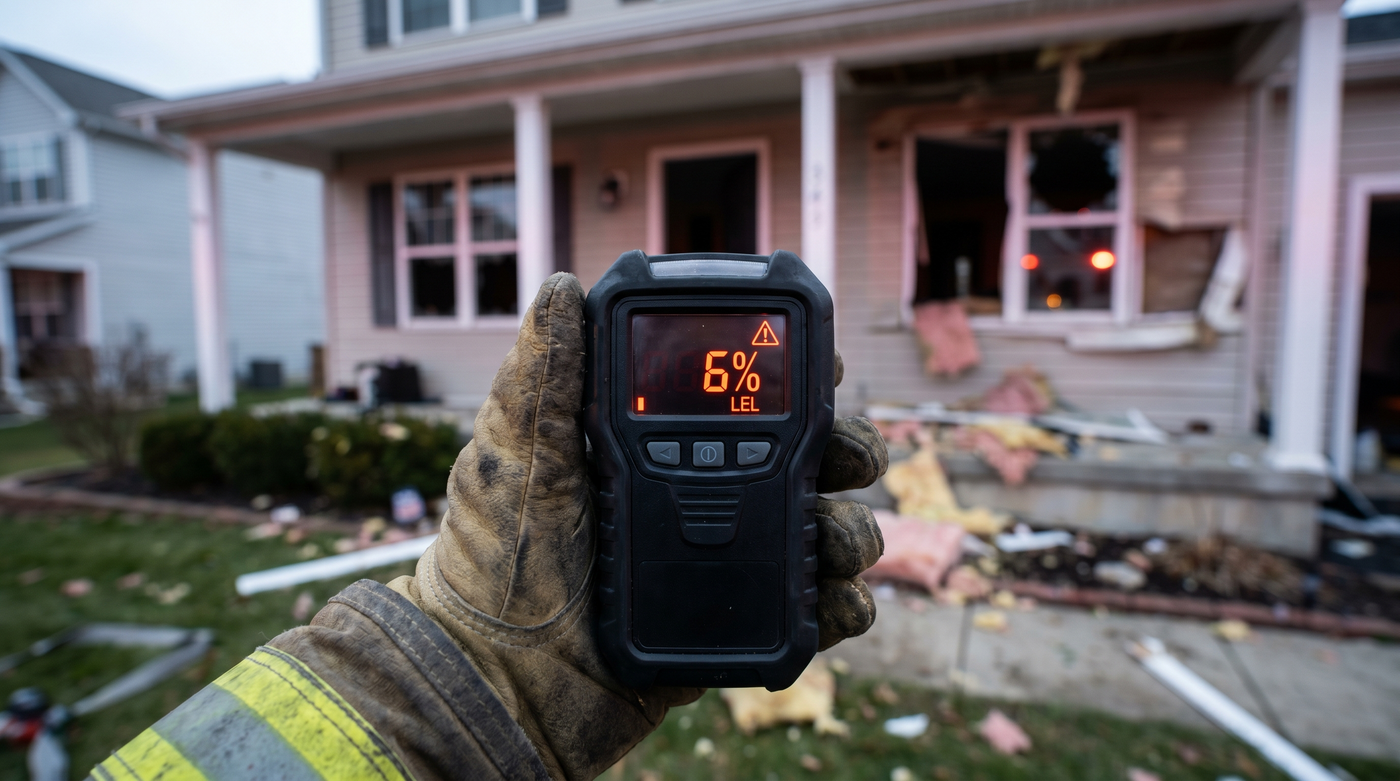
Last November, dispatch sent us to a gas odor report. A neighbor called it in — she could smell propane from across the street.
The mom inside the house met us on the porch.
“I don’t smell anything.”
I asked how long she’d been home. Since 7 AM. Four hours.
I walked in with my meter. Gas reading hit 6% LEL before I cleared the front room. LEL means lower explosive limit. She was inside the flammable range.
Her two kids were on the living room floor watching cartoons. A 3-year-old eating cereal. A 5-year-old on his stomach, face a foot off the ground.
Propane is heavier than air. It sinks. It pools along the floor, under furniture, along baseboards.
That boy’s face was a foot off the ground. He was breathing the highest concentration in the room.
I got them out. Fast. Didn’t explain. Just said let’s go, now, outside.
We found the leak in twenty minutes. Cracked compression fitting under the kitchen sink. Leaking since overnight. She’d probably smelled it at 7 AM — for a few minutes. Then her nose adapted.
She made breakfast. Opened drawers. Closed cabinets. Turned on lights.
Any one of those could have been the spark.
The only reason that house didn’t explode is the concentration hadn’t quite reached ignition point. One more hour. Maybe two.
After we ventilated, I walked the house. And on the hallway wall I saw what I see in almost every house I walk through.
A CO detector. Green light. Working.

I walked back out to the porch. Pointed at it through the window.
“That detector can’t detect propane.”
She looked at me.
“What?”
I told her. It’s a carbon monoxide detector. CO. It reads the gas that comes from burning fuel. Not the fuel itself. It was never built to detect what was in her house this morning.
She sat down on the porch step. Her kids were in the yard. The 3-year-old was picking dandelions.
“Then what was protecting us from that?”
Nothing.
Her nose. And her neighbor’s nose.
That’s not a safety system. That’s luck. And five weeks earlier, I’d stood in the rubble of a family who didn’t have it.
The Blue Backpack

Dispatch said house explosion. We pulled up to what used to be a living room.
The dad was in the front yard. Burns on his arms and face. He’d been thrown through a window, screaming for his kids. The mom was under debris in the hallway. Alive. We got her out in forty minutes. His 13-year-old daughter was in the bathroom — door closed, walls held. Broken arm. Concussion.
His 7-year-old son was in his bedroom directly above the kitchen.
The floor gave way.
I’m not going to describe what I found. I’ll tell you that his blue backpack survived and he didn’t. And that image is going to stay with me for the rest of my career.
Here’s what happened.
A flexible gas connector behind the kitchen stove had cracked. Small crack. Quarter inch. Natural gas had been seeping into the kitchen since sometime around midnight. The house was sealed for winter. Windows shut. Furnace recirculating the same air.
For six hours, gas filled the kitchen. Spread through the hallway. Drifted into the bedrooms.
By 6 AM the house was at explosive concentration.
The dad got up. Same routine as every morning. Walked to the kitchen. Made coffee at 6:15.
He didn’t smell anything.
Six hours of exposure. His nose had stopped registering it hours ago.
He flipped the kitchen light switch.
One spark. In a room full of methane.

I pulled it out. Looked at it. Sensor housing intact. Working perfectly.
Lopez — 11 years on the job — was standing next to me.
“It didn’t go off?”
“It can’t detect gas.”
He stared at me.
“Then what’s it for?”
That question. That face. That pause.
A firefighter with 11 years on the job didn’t know the detector on his own wall couldn’t detect the thing that just killed a 7-year-old.
That’s why I’m writing this.
If Lopez didn’t know — your family doesn’t know either.
Two Different Gases. One Detector Built For Only One.
Here’s the thing nobody told Lopez. Nobody told that mom on the porch. Nobody told the dad on Ridgefield.
Carbon monoxide and natural gas are two completely different things.
Carbon monoxide is what comes out of fuel that’s already burning. Your furnace. Your water heater. Your car engine running in the garage. It’s a poison. It makes you sick. It kills you slowly. Your CO detector was built for this one.
Natural gas — or propane, depending on what your house runs on — is the fuel before anything burns. It comes out of a crack in a line, a loose fitting, a failed connector. It doesn’t poison you. It just fills the room. And then something sparks.
A light switch. A thermostat clicking on. A refrigerator compressor kicking in. A phone screen lighting up on the nightstand.
Any one of those is enough.
And the detector on your wall — the one with the green light, the one you tested last month, the one that “always beeps when you press the button” — has no sensor for the second one. None. It’s a completely different technology.
It’s not malfunctioning. It’s not expired. It’s not the wrong brand. It’s the wrong device.
“But I’d Smell It”
That’s what every parent says.
Maybe. If you’re awake. If the leak just started. If you’ve been outside and walk in fresh.
Here’s what they don’t tell you on the safety pamphlet:
There’s a thing called olfactory fatigue. Your nose adapts. If gas leaks slowly into your house while you sleep — if you’ve been breathing it for four, five, six hours — your brain stops registering the smell entirely.
It’s still there. Your brain just stopped telling you about it.
By morning, you’re standing in a room full of explosive gas and you can’t smell a thing.
That’s what happened on Ridgefield Drive. The dad walked into his kitchen at 6:15 AM. Six hours of gas in the air. His nose had given up hours ago.
He reached for the light switch the same way he did every morning.
And that was the last normal thing that ever happened in that house.
After Ridgefield, I started reading. Not because I wanted to. Because I had to know if what I’d just walked through was rare.
It isn’t.
A gas pipeline incident happens somewhere in the United States about every 40 hours. Between 2010 and 2021, almost 2,600 of them were reported to the federal government. They killed 122 people and injured 603. And that’s just the ones from the main lines — the pipes under the street. It doesn’t count the leaks inside houses from a bad fitting behind the stove or a corroded connector on the dryer. Those get classified as residential fires.
The NTSB — the same agency that investigates plane crashes — has started investigating home gas explosions. Their most recent report said it as plainly as a federal agency ever says anything:
Homes need gas alarms — not just CO detectors.
But most homes don’t have one. Because most people think their CO detector covers it.
It doesn’t.
The One I Bought
Two weeks after Ridgefield, I started looking for a dual-sensor unit. Something that reads CO and combustible gas. Both. One device. Because I was not going to walk into another house and find a CO detector in the rubble and know it was useless against half the threat.
A gas company instructor at a department training said something I haven’t forgotten.
A CO detector in a house with a gas line is half a detector. It catches one thing. The other thing kills you.
He showed me what he keeps in his own house. It’s called AirGuard. A company called Primo Goods makes it. I’m not affiliated with them. I just bought the four-pack — one for my kitchen, one for the hallway, one for the basement, one for my parents’ place.

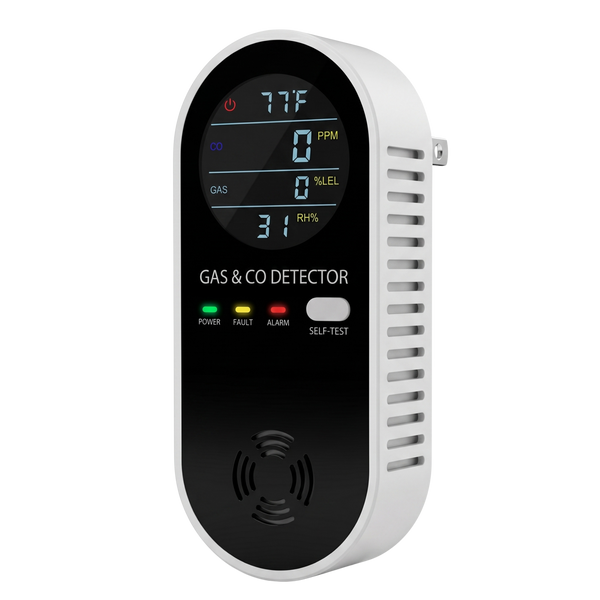
Digital screen. Two sensors — one electrochemical for carbon monoxide, one catalytic for combustible gas. Four readings on one screen: CO in PPM, gas as a percentage of the lower explosive limit, temperature, humidity.
Not a green light. A number. Two numbers that matter.
The first number — CO — is the one your current detector tries to watch. Except AirGuard shows you the actual PPM instead of waiting for 70 to maybe beep.
The second number — gas — is the one your current detector can’t see at all.
That’s the number that would have saved the family on Ridgefield. That’s the number that would have told the mom on the porch step that her house was full of propane before her nose gave up.
0% LEL means clean. Anything above 0% means something is leaking.
You plug it in. No batteries to forget. No ladder. No app to download.
The Morning It Wasn’t Zero
I put one in the kitchen. Right by the gas range. One in the hallway outside the bedrooms — my kids are 9 and 12. One in the basement by the furnace.
Everything read 0 for months. CO and gas. Both numbers. Every day.
Then a Sunday morning in December. Making eggs. All burners off. Oven off.
I glanced at the display.
0 PPM CO.
3% LEL gas.
Three percent. Not explosive. Not close.
But not zero.
I shut off the gas at the main. Called my HVAC tech on Monday. He found a loose compression fitting on the flex connector behind the stove. Barely leaking. So slow you couldn’t hear it, couldn’t smell it in a ventilated kitchen.
$85 fix. Twenty minutes.
He told me the fitting would have loosened more over time. Winter would come. Windows shut. Kitchen sealed.
My kids eat breakfast in that kitchen every morning.
If I’d had my old detector — the CO-only one, the green light — I would have walked past a silent device every morning for months while gas slowly accumulated in the room where my children sit.
Not carbon monoxide. Gas. The kind that explodes.
And the green light would have been on the whole time. Because the green light only watches for the other thing.
Your Furnace Is Going To Turn On
Same as every night.
And the detector on your wall is going to sit there with its green light glowing. Same as every night.
If carbon monoxide leaks from a cracked heat exchanger — it might catch it. Eventually. After 70 PPM. Maybe after four hours.
If natural gas or propane leaks from a fitting, a connector, a valve, a supply line — it won’t make a sound. It wasn’t built to. It doesn’t have the sensor.
And your nose? Your nose works great when you walk in from outside. It doesn’t work at all after six hours of slow exposure while you sleep.
That’s the gap. CO on one side. Gas on the other. One sensor on your wall built for only one of them.
The family on Ridgefield had a detector. Green light. Working. Tested.
The family down the road had a neighbor.
One of those is a safety system.
The other is luck.
I’m not going to tell you what to do. I’m not a salesman.
I’m a guy who found a 7-year-old boy’s blue backpack in the rubble of a house that had a working CO detector and a gas leak it couldn’t see.
You don’t have to buy this one. But get something that reads both. CO and gas. Two sensors. Something with a screen. Something that can show you 3% LEL on a Sunday morning before it ever becomes the reason someone like me has to walk through what’s left of your kitchen.
Don’t bet your family on luck.
Mike — thank you for writing this. I have walked through three of these scenes in my career and the CO detector is always intact, always green-lit, always useless. I tell every new probie the same thing now: if the house has gas service, the CO detector is half the story. Shared this with my whole department.
Tom — appreciate you, brother. The probie part hit me. Lopez was a 11-year guy and even he didn’t know. We’ve got to fix that at the training level.
This made me cry. We had a small gas leak last winter behind our dryer — my husband happened to smell it when he came in from a walk. The CO detector five feet away was completely silent. We had no idea it couldn’t detect what was leaking. Bought four of these the next morning. Thank you for putting this out there.
HVAC tech for 18 years. The number of homes I walk into where the homeowner thinks their CO detector is “the gas detector” is about 9 out of 10. They are not the same. They have never been the same. I keep extras of these in my van now and hand them out at jobs where I find old detectors. Mike is 100% correct on every technical point.
This is my husband and me. We literally thought the CO detector covered everything. Ordered yesterday.
My neighbour had a small propane leak last summer at their cabin — couldn’t smell anything by the time my dad walked in to drop off mail. He had this exact unit on his keychain bag for work (gas company), it spiked the second he opened the door. They evacuated, fixed the fitting. Three lives. The detector inside their cabin? Green light the whole time. Get something that reads both.
I’ve been getting morning headaches for weeks and we just switched to a gas stove in the remodel. Read this last night, ordered one, it arrived today. The display reads 1% LEL in my kitchen right now. ONE PERCENT. Not zero. Calling our plumber tomorrow morning. I might have just saved my kids’ lives because Mike wrote this. I’m shaking.
Allison — please get out and ventilate tonight before bed. Open windows. Shut off the gas at the main if you know where it is. Don’t wait until tomorrow morning. Call your gas company tonight, they’ll come out for free. 1% LEL is the canary — it tends to climb.
Mike thank you — gas company is on their way. Windows open. Kids at my mom’s. I owe you.
I lost a cousin in a house explosion in 2019. Same exact scenario you described — gas leak overnight, no smell by morning, switch flipped. Family of four, only the dog made it because he was on the back porch. I have never been able to read about this until tonight. Thank you for telling it carefully. I ordered five.