
The Plumber Who Noticed What Our "Working" CO Detector Missed For An Entire Winter
I kept blaming the headaches on stress. The fatigue on parenting. The brain fog on perimenopause. It wasn't any of those things. It was the air in our own house — and a small green light that kept telling me everything was fine.
5 min read
The call came on a Tuesday morning in late January. Our plumber — Marcus, the guy who'd fixed our water heater three winters running — was standing in our utility room holding what looked like a glorified vape pen.
"Emily, when did you last have a tech look at this boiler?"
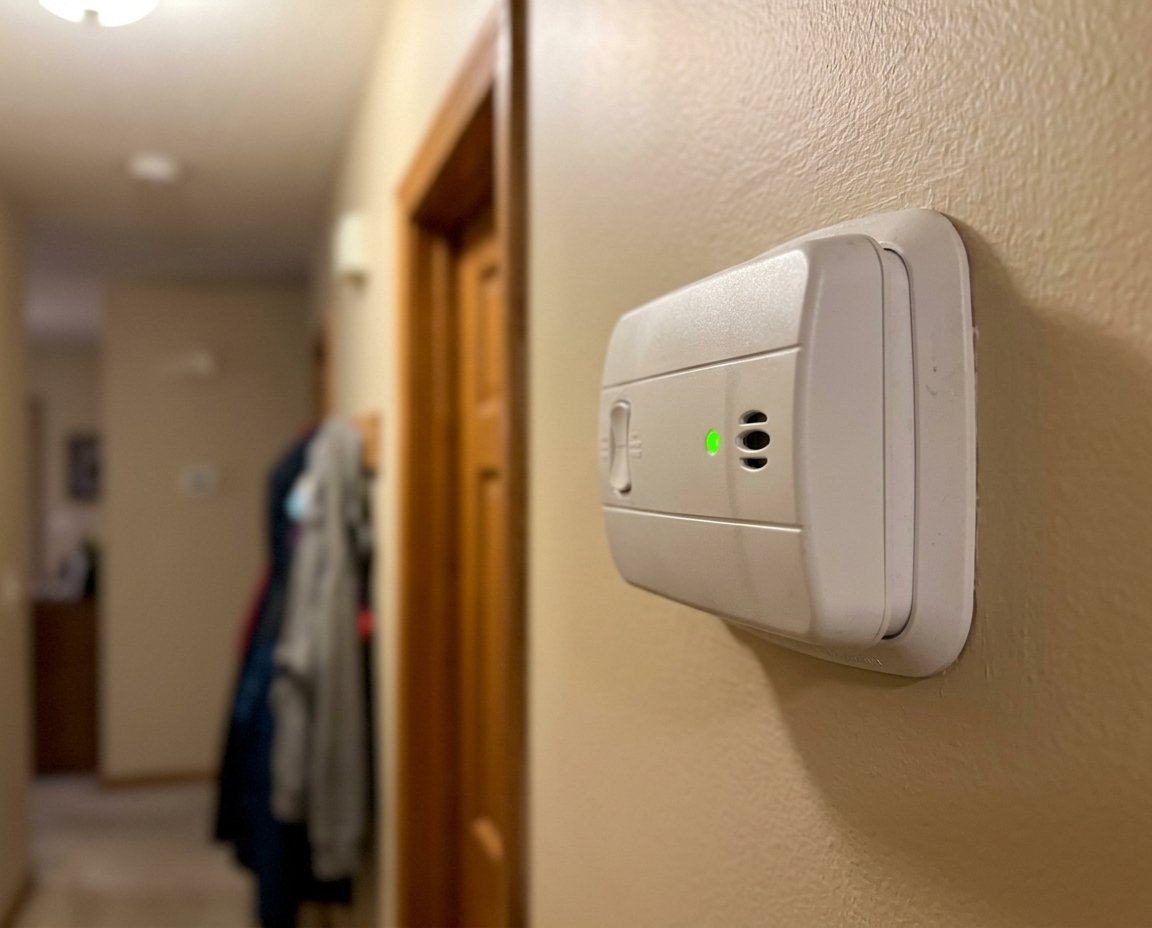
I didn't have a good answer. We'd moved in four years earlier. We had a CO detector on the hallway wall, the kind the previous owners left. I'd tested it when we bought the place. It beeped. I assumed that meant it worked.
Marcus wasn't there for the boiler. He was there to snake a slow bathroom drain. But he'd asked to use our utility sink, and something about the smell in the room stopped him.
He pulled the meter out of his truck "just to check."
32 PPM at the utility door. 28 PPM in the hallway. 22 PPM in my daughter's bedroom — where she'd been sleeping every night for months.
Our detector on that hallway wall? Green light. Silent. Exactly the way it had been every day since we moved in.
I asked Marcus if we should call the gas company.
He said, "Emily, if you had kids in this house last night, you need to open every window right now. Then we call."
The Symptoms I Had Explanations For
Looking back, the clues had been stacking up since October.
My daughter — she's nine — started coming downstairs complaining her head hurt before school. Not every day. Maybe twice a week. I gave her water. Told her to sleep more. Bought a humidifier for her room, thinking it was dry winter air.
The humidifier didn't help. Obviously.
My husband started falling asleep on the couch by 9 PM. He's 41 and generally a night owl. I teased him about getting old. He laughed. We both assumed it was work.
I had the worst one. A dull, low-grade headache that lived behind my eyes from about 4 PM until I went to bed. Some nights I was nauseous enough to skip dinner. I'd read three articles about perimenopause and one about long COVID. I had a doctor's appointment scheduled for the following week.
"The symptoms were real. I just had a plausible story for every one of them — and not a single story was right."
— Emily MarshThe worst part isn't that we were being exposed. The worst part is that there was a device on our wall whose entire job was to tell us, and it never said a word.
Why A "Working" Detector Can Still Miss It
Here's what I learned in the week after Marcus's visit — from a gas company inspector, an indoor air quality specialist I called out of pocket, and more hours on CDC and EPA websites than I care to admit.
Standard household CO alarms aren't designed to catch what we had. They're designed to catch catastrophic events — a cracked heat exchanger dumping 400 PPM into your living room, a generator running in an attached garage, a blocked flue pushing exhaust back into the house at 200+ PPM.
For those events, a standard alarm is genuinely life-saving. That's not nothing.
But the threshold that trips them is deliberately high. UL 2034 — the safety standard — requires alarms to sound between 70 and 400 PPM depending on how long the exposure lasts. The reason isn't evil corporate penny-pinching. It's a real tradeoff: alarms that go off at lower levels generate so many false positives (from gas stoves, cars warming up next door, a cigarette on the patio) that people get frustrated and disable them. A disabled alarm protects nobody.
So the standard is set where it is. Which is fine — until you're the family whose exposure is low, slow, and steady. Chronic low-level CO won't trip a standard alarm. It'll just quietly make you sick.
Our readings sat between 20 and 35 PPM for somewhere around three months. High enough to cause every symptom I'd been rationalizing. Low enough that our detector — doing exactly what it was designed to do — never made a peep.
Source: CDC, National Center for Environmental Health
What Actually Changed Things For Us
The gas company found the cause the next day — a hairline crack in the boiler's heat exchanger. Replacement, not repair. Six days without heat. Two grand we hadn't budgeted for.
Fine. Fixed. Done.
But I couldn't stop thinking about the three months before that. About my daughter sleeping in 22 PPM every night. About how many other families were living the exact same slow leak without knowing it.
I asked the air quality specialist — a former firefighter named Dan who did consulting on the side — what he'd put in his own house.
He didn't hesitate. "Something with a live readout. You want to see the number. The alarm is for when things go wrong. The screen is for catching things before they go wrong."
That's how I found AirGuard.
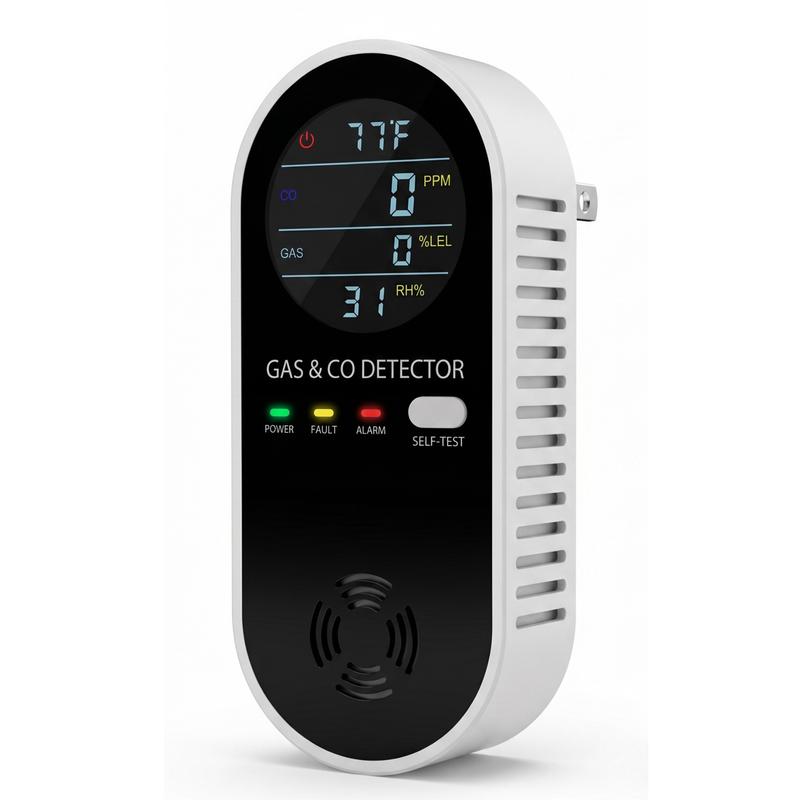
AirGuard Home Monitor
A plug-in monitor with a live digital display — not just an alarm, a continuous reading.
AirGuard isn't a replacement for your code-required CO alarm. That alarm still has a job — it's the last line when things go badly wrong, and if you're building a new house or renovating, your local code will require one regardless.
AirGuard is the first line. The one that gives you information instead of just a binary yes/no.
What makes it different
Live PPM display, always on
Walk past it in the morning, glance at the number. If it's 0, your air is clean. If it's reading 12, you've got something to investigate. You don't wait for an alarm to learn there's a problem.
Four-in-one sensor package
CO, natural gas (methane), propane, and ambient temp/humidity — one unit, one plug. Covers leaks from furnaces, stoves, water heaters, fireplaces.
Plug-in, not hardwired
Standard outlet. No ladder, no drilling, no electrician. Move it from room to room if you want to.
End-of-life indicator
The sensor tells you when it's nearing the end of its useful life. No guessing whether the unit on your wall is still working — or has quietly stopped working two years ago.
What Our Mornings Look Like Now
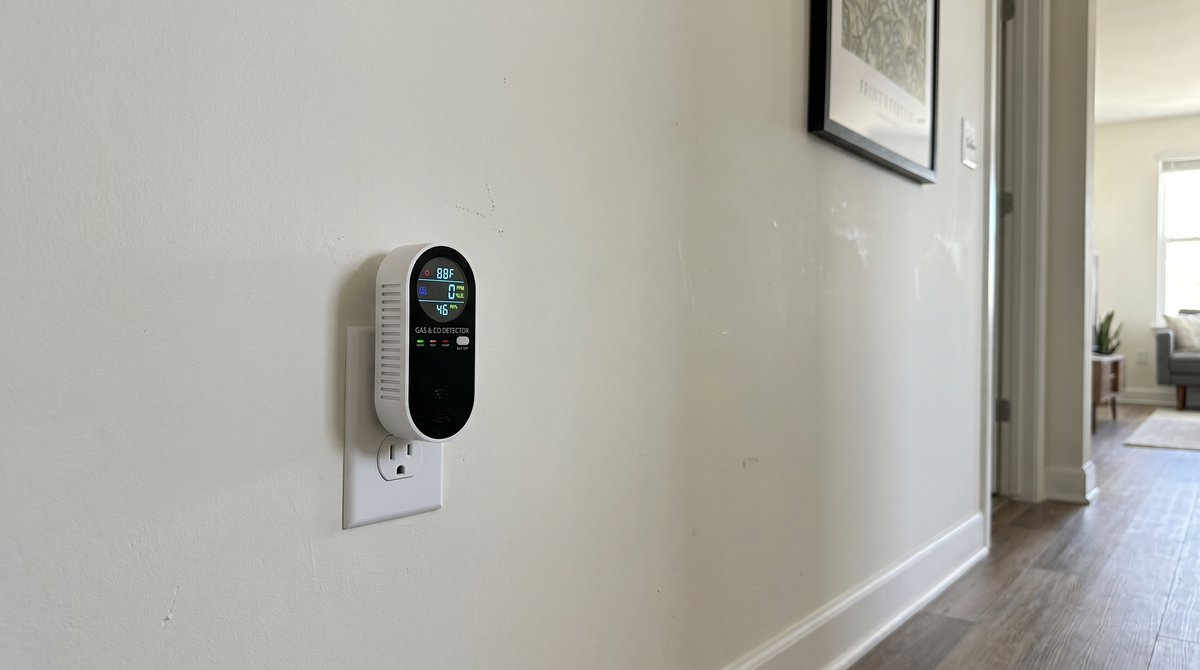
I ordered four AirGuards the weekend after the boiler was fixed. One by the utility room. One in the kitchen near the stove. One in the upstairs hallway. One in my daughter's room.
Every morning I walk past the hallway unit on my way to make coffee. I glance at the number.
It says 0.
Then I go make coffee.
That's it. That's the whole routine. It sounds small — and it is — but the peace of mind is a physical thing I didn't realize I'd been missing. I know my air is clean because I can see it. Not because a green light is telling me to trust that it is.
"I know my air is clean because I can see it — not because a green light is telling me to trust that it is."
— Emily MarshLast month our plumber came back to install a utility sink. Marcus — the guy who started this whole story. He looked at the AirGuard by the boiler and said, "Oh good. That's what I have at my place."
It figures.
Who Should Actually Care About This
Honestly? Anybody who has a furnace, a gas stove, a water heater, an attached garage, a fireplace, or a generator. Which is most people.
But especially:
Parents of young kids. Smaller bodies absorb CO faster. The same level that gives you a headache can put a child down.
Anyone pregnant or trying. Low-level CO exposure during pregnancy is associated with developmental risk. It's one of those things that's hard to study but easy to prevent.
People with older parents living alone. Older adults are more vulnerable and less likely to recognize early symptoms. The live readout lets someone check in remotely: "Hey Mom, what's the number say?"
Anyone with an aging heating system. If your furnace or boiler is 15+ years old, you're statistically more likely to develop the kind of small crack we had.
What other families are saying
"Bought one for my mom after a scare. She called me a week later: 'The screen says 4.' She'd been cooking with a gas range in a poorly vented kitchen for 20 years. We got her vent hood fixed. Worth every penny."
"I work overnight shifts and my wife is home with our son all day. Knowing I can glance at the app reading on my break and see a zero next to his room is a different kind of reassurance than a green light."
"Installed in 30 seconds. Literally plug it in and it works. Our basement reads consistently at 2-3 PPM because of an old furnace — called an HVAC tech, scheduled service. Would never have known otherwise."
If you take one thing from this article…
Don't be where we were in October. Don't rationalize a symptom for three months when the answer is a $50 device that tells you the actual number.
Keep your code-required CO alarm. Add an AirGuard for the early warning. That's the whole advice.
I wish someone had told me this in October. Now I'm telling you.
— Emily
P.S. — If you're shopping for aging parents, the 2-pack is usually enough. For a typical single-family home, most readers go with the 4-pack.